Sunday, 13 August 2017

Peb (Vikatgad) - Matheran Trek

Temple of Pebi Devi at the top most point of Peb fort

At 2100 feet, stands a tall fort behind the famous Matheran hill station - the Peb aka Vikatgad. Peb is becoming a popular trekking center for people near Mumbai and Pune as it is a one-day journey and is well connected to the nearest railway station of Neral. Have you ever wanted to go from one mountain to another part of the mountain range? Well, Peb provides you with an option of a range trek. From the top of Peb fort, you can walk the entire hill and reach the Matheran hill station.


How to reach?

To reach Peb fort, one needs to board the Mumbai local train going towards Karjat or Khopoli on the Central line. Get down at the Neral station and walk right towards the Matheran taxi stand by crossing the Neral-Matheran platform on the Neral station. The morning train timings for Neral from Dadar are as follows:
  • 4.42 am Khopoli Slow local
  • 5:06 am Karjat Slow local
  • 5:38 am Karjat Slow local
  • 6:24 am Karjat Fast-Diva local
  • 7:03 am Karjat Fast-Mulund local
Avoid getting late for any trek as earliest you go better the journey.

When you arrive at the taxi stand, you can have breakfast at local restaurants and food shops. The base village for this trek is Anandwadi of Fanaswadi; local autos charge around Rs 25-30 to take you to the base village, which is approx. 4 km from the Neral station. Walking towards the base village may take up to an hour, so a wise option would be to use the local transport which leaves you at the foothills of the fort from where the trail begins.

Place at which the local Rickshaws will drop you

The bridge from where the trail begins


Difficulty Level

For people with prior trekking experiences, the trek is a medium grade and for a novice or casual trekker, it becomes a medium to hard grade. One can easily get lost in the jungle as the trek to Peb has lots of paths and small trails. Hence if you do not have prior trekking experiences (say of more than 5-7 treks), a wise option would be to hire local guide that costs around Rs 500.

The route towards the Peb fort is also known as the 'Tower Route' as one needs to follow the large electric towers that guide you towards the first half of the trek. The goal is to follow the track besides these towers and reach the second electric tower.

Tower Route - Towers that guide you during the first part of the trek

Second electric tower

From here on, from the second electric tower the trail is a one-way trail and the difficulty level rises a bit.

After reaching the second electric tower follow the route in front of the electric tower


Time to reach the top most point

This trek can take up to 2.5-3 hrs to reach the pinnacle. The rock patches here are quite large, and the distance between them is more hence it becomes very difficult to climb such rocks also they are steep and a majority of the rock patches are in the path of flowing water hence they are slippery. After reaching first huge chunk of boulder rocks, you need to take left and go through a canopy of dense vegetation.

Boulder rocks
Dense jungle trail begins

The most difficult part of the trek is the huge 10-12 feet rock patch which becomes difficult to climb or get down even for people with prior trekking experience. Hence one needs to carefully climb this rock patch. A rope is provided here for support but it is loosely bound; hence better to climb with bare hands.

The difficult 10-12ft high rock patch

After this rock patch, the climb becomes slightly easy and you encounter iron ladders from where there are stairs that take you to the pinnacle of the fort.

Iron Ladders
Iron Ladders


Lord Hanuman carved out of rocks - just after the iron ladder

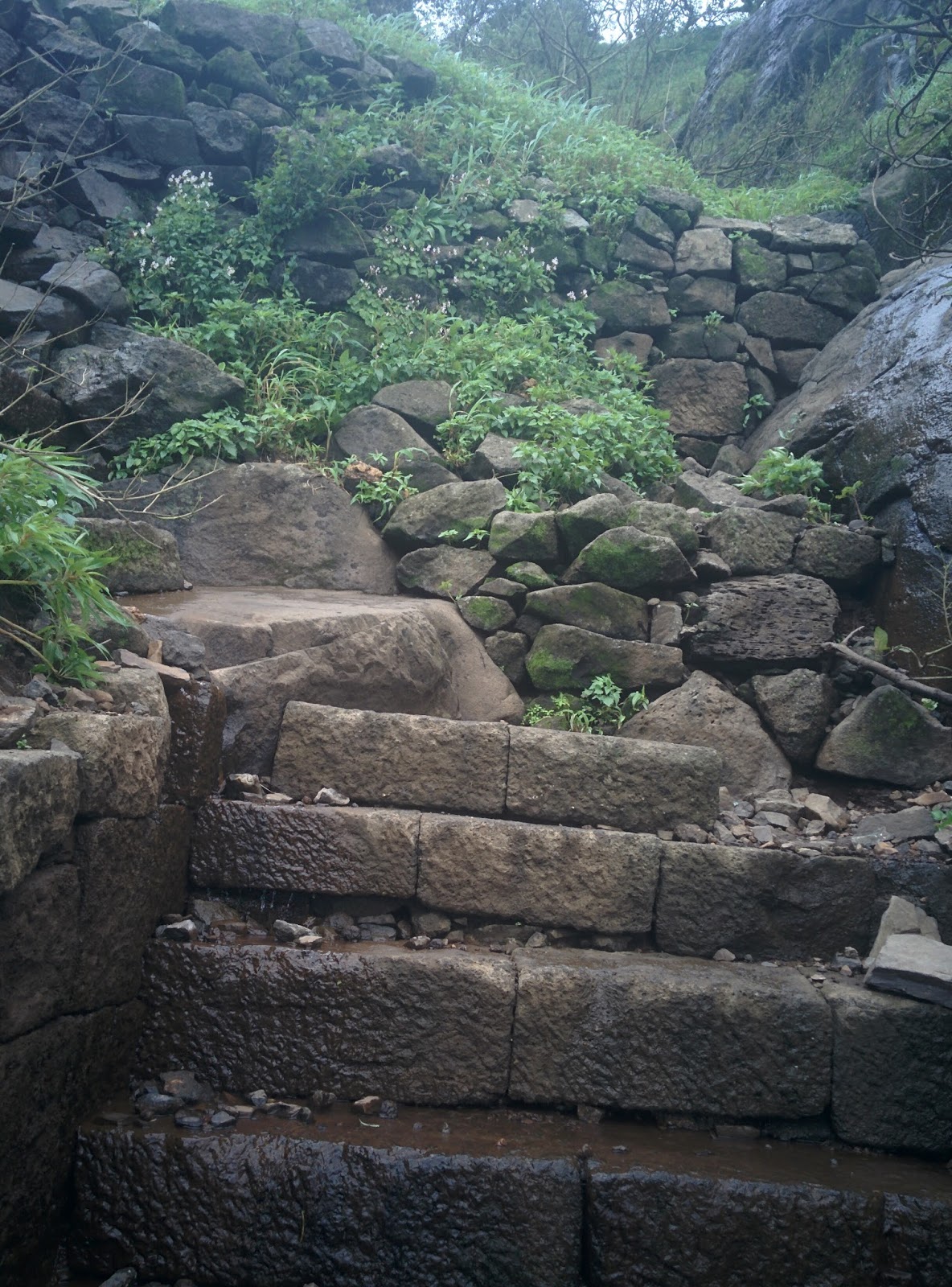
Steps towards the pinnacle of the fort

What to see

Before the first set of ladders, there are caves which were used to store food grains and ammunition. Also, a cave is dedicated to Swami Samarth Maharaj, however, there is no proper historical mention of him staying here. You can relax here in these caves and overnight stay is possible, with the cave providing a capacity of 25-30 people. When you reach the top there is a temple of goddess Pebi after which the name of the fort, 'Peb' is kept.

Remains of the fortification

Ancient remains of the fort

Goddess Pebi temple


Descend - Matheran Route Details

From the top you have two options, descending down the same route of ascend or travel from one hill to another i.e. from Peb fort hill to Matheran hill. Latter is an easy route and can up to 45-60 mins to reach the Matheran railway tracks. This route starts after a small ladder from this dome shaped gate. 

Gate from where route to Matheran hill station starts

After 5 mins of walk from this point, a downhill trail is encountered towards the left which takes you to the second set of ladders.


The route from here is simple, no more rock patches or steep climbs, just that the route is narrow with cliff on the side, but easy.

Final uphill

Final ladder of the trek

After climbing the final ladder you will find the board towards the 'Kadyavarcha Ganpati - Nisarg Raja'. This Ganpati adds to the beauty of the Matheran hill, and stands amidst the beautiful green hills, and hence appropriately named 'Nisarg Raja' or King of the Nature. The view is just mesmerizing!

Sign board guiding towards Kadyacha Ganpati


Kadyavarcha Ganpati

Small Ganpati Idol


The view of Kadyavarcha Ganpati from the Matheran hill

The Peb-Matheran trek ends here and after a walk of 15-20 mins along the railway track, a small taxi pickup point is encountered. They charge around Rs 80 per seat and leave you at the Neral railway station from where you can take a train back to home.


My Experience

As decided me and my fellow trekkers (team of six) were to catch the 6:24 am Karjat local from Dadar, which alighted Neral station at 6:44 am. The train was late, it reached 20 mins late at 8:10 am; upon reaching we had the usual breakfast of Misal-Pav, Idli and chai at a local restaurant just outside the station,. After breakfast, we found a rickshaw that was charging us Rs 200 towards the base of the Peb fort, we negotiated with him and finally charged Rs 150. After 25 mins of auto ride, we reached the base village Fanaswadi, the start point of the trek. At about 9 am our trek started. There were multiple paths and trails, we just kept the electric towers as a reference and completed the first part of the trek at around 9:45 am.

Resting after reaching the second tower

We acquired speed and started moving quickly. The difficult 10 ft rock high patch was a challenge, but our group of trekkers is a fearless one, nothing could stop us 😄.


We missed the turn towards the Swami Samarth caves and went directly towards the first set of ladders. Next time for sure we gonna visit them when we again do the Peb Trek 😇. At 12 pm we reached the top point, at the Temple of Pebi devi (about 3 hrs ascend), relaxed a bit and started moving towards the Matheran route. Enroute we visited the magnificent Kadyavarcha Ganpati took blessings from the Elephant God and reached the Matheran railway tracks. On the way, a small waterfall was available so relaxed a bit there and started the return journey. A truly mesmerizing experience! Our total expenditure for this trek was about a mere Rs 150 including traveling.


Summary of this trek


  • Nearest railway station - Neral (Central line)
  • Base village - Fanaswadi or Anandwadi
  • Average Expenditure - Rs 150-180
  • Difficulty level - Medium for regular trekkers and Hard for casual trekkers
  • Route - Follow the three towers from the base village or hire a guide (Rs 500)


Tips


  1. Descend via the Peb route is difficult; hence always ascend from the Fanaswadi (Tower route) and descend via the Matheran route.
  2. Peb has multiple paths that might misguide you eventually getting lost, hence ask for directions from the villagers or hire a local guide.
  3. Carry at-least 3 liters of water, medicines and first aid kit for safety.
  4. Carry your own food like biscuits, fruits such as bananas, etc.

KEEP NATURE AND SURROUNDING ENVIRONMENT CLEAN

Tuesday, 11 July 2017

Mahuli Fort Trek - Asangaon


If you are a fan of rock-climbing, then this is the place you definitely want to visit. Mahuli fort is also known as the 'Everest of Thane' which at a height of 2815 feet (815 meters) above sea level, the highest point in the district of Thane. The trek route offers some exceptional views of adjoining mountain ranges; also being a part of the Tansa Wildlife, Sanctuary there's a chance of spotting some rare species of flora and fauna.


How to Reach?

Base village for Mahuli fort is the Mahuli village itself. You need to get down at Asangaon Local Station (central line) and from there autorickshaws are available that charge you Rs 250 for three persons or Rs 350 for four persons. Also, a cheaper option would be to go to the Highway and board an ST bus that charges Rs 10. Autos and buses leave you till the foothills of the fort. Upon reaching one needs to pay Rs 20 charged by the local Mahuli Paryatan Kendra. The route is well marked and also has a waterfall on the other side towards the left, boards and marking towards the waterfall are provided.

Difficulty Level:

People with prior trekking experience will find it easy to trek Mahuli fort and for intermediate or beginners it is a medium level trek. Route is well-marked and easy to trek and has very less risky rock patches as compared to other places like Kalavantin Durg or Harishchadragad. Railings and ladders are provided at risky places, though one needs to take proper care while rock climbing especially in the monsoon. After trekking for around 2-2.5 hrs, you will encounter an iron ladder, put up by the local authorities. This marks the end of the trek. Descend time is about 2 hrs.

What to see?

Mahuli fort area is large and is a combination of two other forts - Bhandargad and Palasgad. Top of the fort has markings to guide you towards these forts. On an average it takes 45 mins to reach Bhandargad and about 30 mins to reach Palasgad. There are also some caves on the way towards the 'Mahadarwaja'. One can take overnight shelter here if planning for a night trek.


Best Time to Visit:

Monsoon (June - September).
In the monsoon season, the trek route is flooded with water hence water is thoroughly available but one needs to carry at least 3-4 litres of water if trekking in summer.

History:

The creator of this fort are Mughals. In 1485 this place came under rule Nijamshahi dynasty. When Shahaji Raje became the secretary of Nijamshahi, Mughals of Delhi tried to end Nijamshahi. In 1635-36, Shahaji Raje transferred himself with Jijabai and Shivaji to Mahuli. When Khan Jaman attacked the fort, Shahaji asked Portuguese for help, who refused and Shahaji surrendered.
Shivaji took this fort from Mughals on 8 Jan 1658. In 1661 it was given back and was won again by Shivaji. In treaty of Purandar, in 1665, Marathas lost these forts again. In Feb 1670, Shivaji Maharaj tried to conquer Mahuli, but failed, Manohardas Gaud, was the in charge of the fort. A thousand Marathas were killed.Most of them were from nearby villages.Shivaji Maharaj said to his dead kadam sardar he is our gold. So maharaj gave the Sonare surname to this family. Manohardas Gaud, soon gave up his position and Alveerdi Beg took over. On 16 June 1670, after two months, Moropant Pingle conquered the forts and Mahuli, Bhandargad and Palasgad became part of Swarajya. Till 1817, Shivaji's dynasty owned the fort but later on it was controlled by the British Raj.
(Credits: Wikipedia).

My Experience:

I started my journey early in the morning at 4 am from Kandivali, Mumbai with a mate coming from Mira Road. We took the first train from Dadar at 5.18 am and reached Asangaon Station at 7.15 am. Outside the station, we met a group of 13 people and joined them. Now we were a group of 15. After an autorickshaw ride of about half an hour, we reached the base of the fort. Had refreshments (Bhaji, Misal Paav and chai) and started trekking  at 8.30 pm. We reached the top within 2.5 hrs explored the entire Mahuli fort and other adjoining places and started descending at 2.30 pm. It took 2 hrs to descend. After reaching down we called one of the auto-wallahs and reached the Asangaon station at 5.15 pm. Finally after a local train journey of 3 hrs I reached home at 9.30 pm.


KEEP NATURE AND SURROUNDING ATMOSPHERE CLEAN